

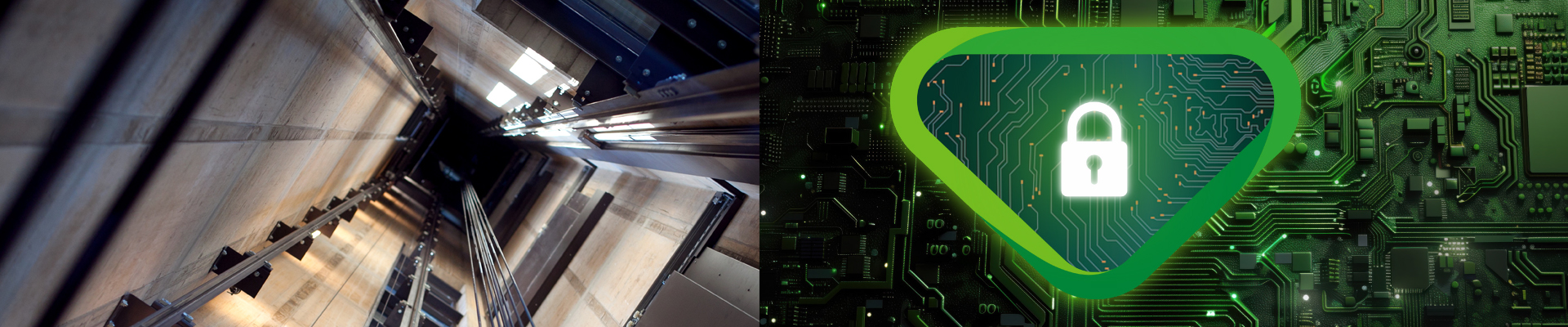

With the growth of the number of remote and IoT applications in elevators, escalators and moving walks, it was high time to issue a standard in the field of cybersecurity. The International Standards Organization has taken up that task and published ISO 8102-20.
With its new expert training courses on Cybersecurity and Functional Safety (IEC61508), Liftinstituut is the first to offer a training program in this specific field, fully focused on the lift and escalator industry. A unique opportunity for professionals in the industry to be trained this specific.
Due to popular demand, Liftinstituut has recorded the third series of Expert Sessions. In this new series of short video discussions, experts from all over the world share their knowledge, experience and views on different vertical-transportation subjects. The first Expert Session is already available. Pieter Schaareman, Product Specialist at Liftinstituut, Managing Codes and Standards, will update you on the latest developments concerning European standards and international regulations.
In its ambition to make the world of lifts and escalators a bit safer every day, Liftinstituut has acquired the Valencia based Iseval Grupo since 12 July 2022. The move follows earlier expansion of safety inspections in Finland, Ireland, the Caribbean and Singapore. By joining forces with the renowned company Iseval Grupo, Liftinstituut aims to contribute to the safety of millions of Spanish lift and escalator users.
The largest international trade fair for lifts Interlift will be held from 26 to 29 April in Messe Augsburg in Germany. Liftinstituut is present at this fair. You can find us in hall 3, booth 3193. Visitors from all over the world will turn to the booth for information about safety, certification and training. On April 27th you can also attend the Liftinstituut presentation on lift safety at the VFA-Forum Interlift.
To protect elevator users even more against elevator door strikes, the North American standard for elevators now includes new safety requirements. Besides 2D-protection by a light curtain, the standard demands that approaching passengers are also detected. Sensor specialist CEDES has therefore introduced the new CabSafe system. The system was certified by Liftinstituut.
Manufacturers all around the world choose Liftinstituut for its specific elevator certification expertise. To meet the growing demand and to serve customers in even more areas of expertise, Liftinstituut has expanded its international team with five experts. International business manager Albert-Jan van Ommen says: “With this team we are ready to achieve further growth.”
The UK Government announced on August 25, 2021 that the transition to mandatory UKCA marking of the new CE marked goods has been extended by one year to 1 January 2023. They believe due to the impact that it is necessary for businesses to make the proper and timeconsuming arrangements.
After months of preparation, certification organisation Liftinstituut will start the first conversion from an EU to a UKCA-type certificate in early July. The process, which is taking place in close cooperation with a lift producer and the British certification partner LiftCert, is seen as a pilot project. ‘It brings us a chance to identify potential obstacles in the process at an early stage and to improve the process where necessary,’ says Liftinstituut account manager Dennis Lindeboom.
In March 2021, the scope of the ANAB* accreditation of Liftinstituut was extended. In addition to product certifications based on the ASME A17.7/CSA B44.7 performance based code, the Accredited Elevator/Escalator Certification Organization (AECO) Liftinstituut may now perform product certifications in North America on the basis of the ASME A17.1/CSA B44 prescriptive code. This will enable Liftinstituut to improve its services to all players in the sector of lifts and lift components.
Including requirements for type examination of the safety components
The SS 550:2020 (Code of Practice for Installation, Operation and Maintenance of Electric Passenger and Goods Lifts) was launched on 8 January 2021 at the Webinar “SS 550:2020 Code of Practice for Installation, Operation and Maintenance of Electric Passenger and Goods Lifts”, organised by Enterprise Singapore.
With Brexit on the way, many producers of lifts and safety components are concerned about the validity of their EU safety certificates in the United Kingdom. Business Manager Albert-Jan van Ommen van Liftinstituut: “From January 1, many products require UKCA marking. The difference between an EU certificate and UKCA marking is negligible. The UK has almost the same safety regulations as the EU. So the new certificate will mainly be an administrative act.”
Annual random checks (EU) and surveillance assessments (North America) are used to check whether a product in stock still matches the product for which an EU or AECO type certificate was initially issued. During the COVID-19 period, Liftinstituut can also provide these checks and assessments remotely. This guarantees the continuity of your certification and assures you that your products comply with the latest laws and regulations.
Stacy Georges, product manager at the US company Hollister Whitney, asked Liftinstituut to certify three new rope grippers. Partly because of COVID-19 and resulting travel restrictions, the certification took place remotely. The test coordinator in the Chinese laboratory performed the various tests, while Stacy and Liftinstituut certification specialist Hessel Kramer monitored everything remotely. What were their experiences with this method of certification?
Since our first energy measurement of lifts in 2009, the norms have continued to develop. Along with the VDI 4707-1 guideline, there is now ISO 25745 that describes the norms for escalators and moving walks. In part 1 of the ‘ISO 25745 under the microscope’ series, we shall examine: How is the standard designed? Why doesn’t this norm form the basis for type certification? And does the norm take sustainability aspects into consideration?
Along with the VDI 4707-1 guideline, there is now ISO 25745 that describes the norms for energy measurements of lifts, escalators and moving walks. In part 2 of the ‘ISO 25745 under the microscope’ series, we shall examine: How does Liftinstituut apply this norm to energy measurements? And why does the first measurement not always produce the desired result?
Liftinstituut has a lot of experience with measuring the energy use and producing energy labels in conformance with EN-ISO 25745. The measurements according to the new standard offer more opportunities for building owners, building managers and manufacturers of lifts, escalators and moving walks. A building scores additional BREEAM points when it has an EPC certificate. And with an energy measurement, the manufacturer can directly demonstrate the energy-saving effect of the investments in modernisation.
At airports, train and metro stations, escalators form the important lifeline in vertical transport flows. Most station or airport managers would prefer to avoid an escalator that stops running during rush hour. That is why they prefer to invest in a solid escalator with a long service life. Escalator manufacturers respond to this with so-called ‘heavy duty escalators’ in their product portfolio. “However, not all heavy duty escalators are the same”, escalator expert Azaad Santoe of Liftinstituut says.
The technological developments and innovations within the world of lift systems and lift components follow each other in quick succession. So how does a government deal with the growing number of products that deviate from the standard? How do you offer more technological and innovation freedom while ensuring national lift safety? An increasing number of governments contacts Liftinstituut with these types of questions. “We help them draw up or adjust the inspection regime and implement the legislation to ensure any deviations from the standard are implemented safely.”
In the lift industry, functional safety is more than ever a hot topic. During our four free webinars on this theme, we have noticed that it is an important issue in the branch. No fewer than 400 interested persons signed up for them. Did you miss the webinars? You can watch them all for free.